


VALVE JOB???


Thread Starter
|
Senior Member
Joined: Jul 2006
Posts: 468
Likes: 0
From:
 VALVE JOB???
alrighty then, I have nevertackled a valve job with a dual over head cam engine with shims and buckets..
and i REALLY hate the idea of having to buy shims for how big the gap is because i hear they are pretty expensive for how small they are..
i was woundering if there are any experiancedmechanics out there that have a few tricks up there sleave for gettin the job done moreeffeiciantly then what the manual says... cause threw my experiance the manual usually takes you the long way around things..
also, i have the full service manual and i have read it threw and threw so i know the proccess.. and what tools i need..
its a 1993 GSX-R 750.
I know its not a honda, but for 500 bucks i think anyone with a brain would jump on a good deal when they saw one..
thanks guys!
and i REALLY hate the idea of having to buy shims for how big the gap is because i hear they are pretty expensive for how small they are..
i was woundering if there are any experiancedmechanics out there that have a few tricks up there sleave for gettin the job done moreeffeiciantly then what the manual says... cause threw my experiance the manual usually takes you the long way around things..
also, i have the full service manual and i have read it threw and threw so i know the proccess.. and what tools i need..
its a 1993 GSX-R 750.
I know its not a honda, but for 500 bucks i think anyone with a brain would jump on a good deal when they saw one..
thanks guys!

Member
Joined: Aug 2007
Posts: 2,609
Likes: 0
From: San Diego CA
RE: VALVE JOB???
I...can't really help with the valves, other than to recommend Clymer manuals over the factory ones--I just had to come on and say THANK YOU for not calling it a...a...calling it a 'gixxer'.
Thread Starter
|
Senior Member
Joined: Jul 2006
Posts: 468
Likes: 0
From:
RE: VALVE JOB???
haha, yea i hate that too.. i was expecting to get "you should have bought a honda..." from most people..
why clymer?
ive always gone straight to the factory for tourqe specs and valve clearances and what not...
i will look into a clymer.. it would be interesting to compare them side by side..
why clymer?
ive always gone straight to the factory for tourqe specs and valve clearances and what not...
i will look into a clymer.. it would be interesting to compare them side by side..

Joined: Dec 2006
Posts: 1,353
Likes: 0
From:
RE: VALVE JOB???
This guy is pretty general but right.
I've never done a valve with shims either, only the screw type...but it's just a different job, not a harder one.
You'll need some feeler gauges of course...then...
http://www.dansmc.com/valveclearence.htm
I've never done a valve with shims either, only the screw type...but it's just a different job, not a harder one.
You'll need some feeler gauges of course...then...
The engine must be dead cold before we can adjust anything, so let it sit overnight. First, we will 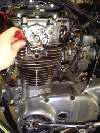 need to find Top-Dead-Center(TDC) of the compression stroke of the cylinder to be checked. Remove the gas tank, the covers to the valves and the cover to the nut on the crankshaft or flywheel. Turn the engine over until you see the intake valve go down and then up. There will be a mark on the crankcase and a "T" mark on the flywheel. When those two marks align, the engine will be at TDC and both intake and exhaust valves should be loose.
swap shims between valves, tight one for a loose one, and save some money there.
Get the valve cover off. On most shim engines that entails 10-20 bolts, a real fragile gasket that is easy to break and a big H shaped cover. Now you will find that things look a bit different from a rocker engine... namely, there aren't any rockers. You will notice the cam and the shim are real close together. To get that shim out first rotate the shim bucket till the notch on it is out. Then rotate the engine so the cam lobe pushes the shim and shim bucket down. Now you use a special tool to hold the edge of the shim bucket down and rotate the cam lobe out of the way. Reach in the notch with a small screw driver and pop the shim up. Remove it with tweezers. Look on the down side of the shim and it will give you it's size. If you can't make out the numbers, measure it with dial calipers. Now when you put in the special too be very careful and don't force anything. Go slow. It all should feel very smooth. If it feels like it is binding... IT IS. DON'T FORCE IT you can break very expensive parts very easily. Consider yourself warned !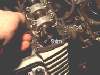 The Yamaha XS series of engines uses a different tool. But the idea is still the same. Naturally, there are different tools for each make of engine. The tools are not too expensive so I just buy them, but I think you could make them too. They all work on the same principle. You have to hold down the edge of the shim bucket, but not the shim, against the valve spring pressure. Some engines, like the KX650 Kawasaki, have the shim UNDER the shim bucket. You must remove the cams to adjust the valves. There are some others that do that too. Real smart work fellows ! The shims come in different diameters too. You can use the same shim in different make engines as long as they are the same diameter and, of course, the right thickness. Always put the side with the size stamped on it in down. That is so the cam lobe will not wear the size markings off.
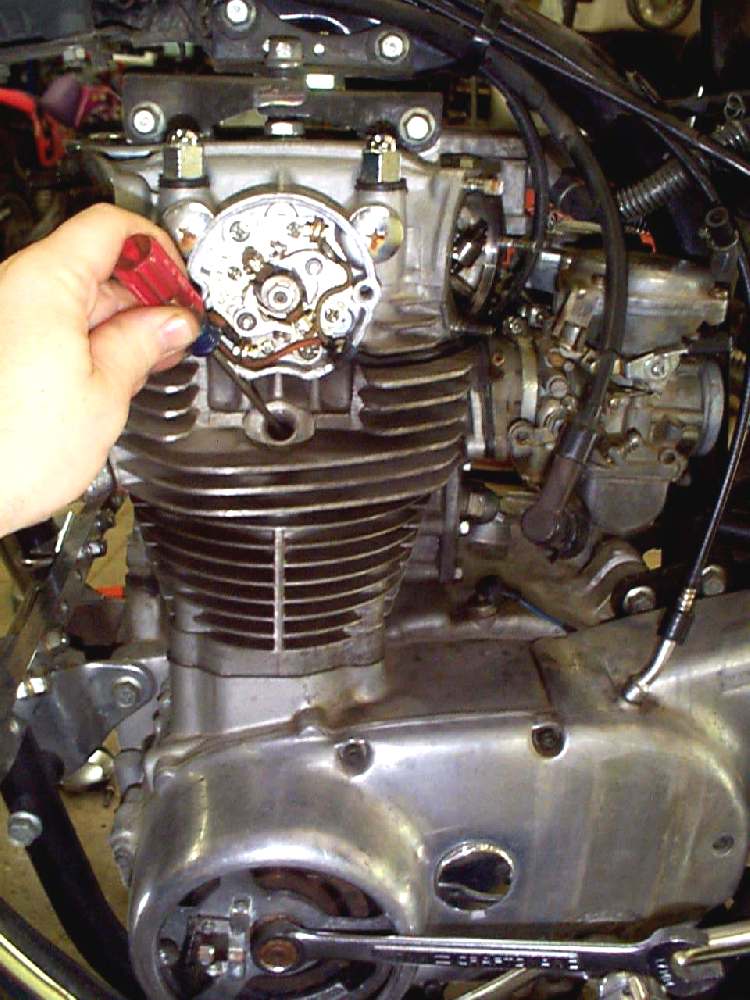 need to find Top-Dead-Center(TDC) of the compression stroke of the cylinder to be checked. Remove the gas tank, the covers to the valves and the cover to the nut on the crankshaft or flywheel. Turn the engine over until you see the intake valve go down and then up. There will be a mark on the crankcase and a "T" mark on the flywheel. When those two marks align, the engine will be at TDC and both intake and exhaust valves should be loose.
swap shims between valves, tight one for a loose one, and save some money there.
Get the valve cover off. On most shim engines that entails 10-20 bolts, a real fragile gasket that is easy to break and a big H shaped cover. Now you will find that things look a bit different from a rocker engine... namely, there aren't any rockers. You will notice the cam and the shim are real close together. To get that shim out first rotate the shim bucket till the notch on it is out. Then rotate the engine so the cam lobe pushes the shim and shim bucket down. Now you use a special tool to hold the edge of the shim bucket down and rotate the cam lobe out of the way. Reach in the notch with a small screw driver and pop the shim up. Remove it with tweezers. Look on the down side of the shim and it will give you it's size. If you can't make out the numbers, measure it with dial calipers. Now when you put in the special too be very careful and don't force anything. Go slow. It all should feel very smooth. If it feels like it is binding... IT IS. DON'T FORCE IT you can break very expensive parts very easily. Consider yourself warned !
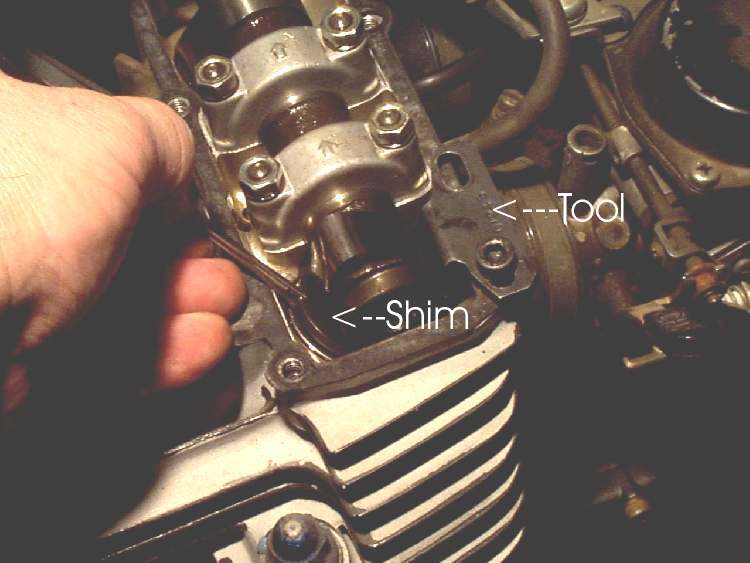 The Yamaha XS series of engines uses a different tool. But the idea is still the same. Naturally, there are different tools for each make of engine. The tools are not too expensive so I just buy them, but I think you could make them too. They all work on the same principle. You have to hold down the edge of the shim bucket, but not the shim, against the valve spring pressure. Some engines, like the KX650 Kawasaki, have the shim UNDER the shim bucket. You must remove the cams to adjust the valves. There are some others that do that too. Real smart work fellows ! The shims come in different diameters too. You can use the same shim in different make engines as long as they are the same diameter and, of course, the right thickness. Always put the side with the size stamped on it in down. That is so the cam lobe will not wear the size markings off.
Member
Joined: Aug 2007
Posts: 2,609
Likes: 0
From: San Diego CA
RE: VALVE JOB???
My factory service manual assumes a lot about my mechanical skill and will always footnote to the Honda common service manual exactly when I need something the most.
The Clymer is fantastic. It's nearly an inch and a half thick full of step-by-step instructions designed for people that may be 'working on the bike for the first time'. If you can imagine anything that needs to be done to the bike, it's in there, with photos, torque specs, and everything else. It'll show you how to adjust the mirrors as well as it describes how to split the case and extract the crankshaft.
The only thing is I can't find one that specifically has 93-95 GSX-R750's. There's this one, but neither Clymer nor Haynes have one--and I know liquid cooling came onto the GSX-R right around that time. I'll keep looking...

clicky Clymer goods
...wow, yeah, there's zilch. Here's this, but it sounds like you already have it. Sorry man.
The Clymer is fantastic. It's nearly an inch and a half thick full of step-by-step instructions designed for people that may be 'working on the bike for the first time'. If you can imagine anything that needs to be done to the bike, it's in there, with photos, torque specs, and everything else. It'll show you how to adjust the mirrors as well as it describes how to split the case and extract the crankshaft.
The only thing is I can't find one that specifically has 93-95 GSX-R750's. There's this one, but neither Clymer nor Haynes have one--and I know liquid cooling came onto the GSX-R right around that time. I'll keep looking...
clicky Clymer goods
...wow, yeah, there's zilch. Here's this, but it sounds like you already have it. Sorry man.
Thread Starter
|
Senior Member
Joined: Jul 2006
Posts: 468
Likes: 0
From:
RE: VALVE JOB???
ohh i see.. yea..
The factory service manual you do need experiance to follow it in the harder steps..
LOL.. like on the fork seals, it says to "slowly split the inner tube from the outer tube"
if any of you have ever done fork seals, you know its exactly the opposite! hahaha.. funny ****..
but anyways, The 93 was the first GSX-R with liquid cooling..
my model is the 1993 GSX-R 750W
if that helps any..
i believe the W stands for "water"
The factory service manual you do need experiance to follow it in the harder steps..
LOL.. like on the fork seals, it says to "slowly split the inner tube from the outer tube"
if any of you have ever done fork seals, you know its exactly the opposite! hahaha.. funny ****..
but anyways, The 93 was the first GSX-R with liquid cooling..
my model is the 1993 GSX-R 750W
if that helps any..
i believe the W stands for "water"

Joined: Dec 2006
Posts: 1,353
Likes: 0
From:
RE: VALVE JOB???
ORIGINAL: BROOKLYN
I respect anyone whom tackles this job.I wish I had the ***** to do mine.
I respect anyone whom tackles this job.I wish I had the ***** to do mine.
I used to adjust valves on mostly late 80's and early 90's Goldwings and the occasional little classic standard bike.
I was working in a small shop at the time, in other words getting paid to do it.
These days, since I usually make enough by working, I'd probably just let a known, good, mechanic do the work.
Notice I said mechanic, not a technician. Dealers are full of techs these days that don't know their a** from a hole in the ground.
You are looking at 3 hours labor at least, by the time the body work, and plugs, and head and gaskets, etc. etc come off.
You might get a cheaper and better job done by removing all the bodywork yourself, and taking it up there naked.

Senior Member
Joined: Jul 2006
Posts: 2,473
Likes: 3
From: Newcastle, N.S.W. Australia
RE: VALVE JOB???
I tried doing (& succeded) on my Kwaka Z650, they needed a "Special tool" to lift the cams up to slide out & replace the shims. I fabricated the tool using an old steering head wrench from a Yammie that I once owned & grinder.
The whole exercise was a pain in the ****, swore I'd never attempt in again. Mainly that once you have the clearances, you then have to troll down to the bike shop, get the right ones & troll home again.
The job itself is not that bad really, its just a matter of getting everything thing off thats needed for access. The Honda's a more of a pain though. (thats where the cost saving comes from)
These days the shop does it, I take my bike in the day before so that its stone cold, the next day. The tolerances on the motor are so fine that any heat can throw the clearances measurements right out.
But there is a alot of satifaction (& blooded fingers & knuckles) waiting for those who do it themselves. (& you will need a torque wrench)
The whole exercise was a pain in the ****, swore I'd never attempt in again. Mainly that once you have the clearances, you then have to troll down to the bike shop, get the right ones & troll home again.
The job itself is not that bad really, its just a matter of getting everything thing off thats needed for access. The Honda's a more of a pain though. (thats where the cost saving comes from)
These days the shop does it, I take my bike in the day before so that its stone cold, the next day. The tolerances on the motor are so fine that any heat can throw the clearances measurements right out.
But there is a alot of satifaction (& blooded fingers & knuckles) waiting for those who do it themselves. (& you will need a torque wrench)
Thread Starter
|
Senior Member
Joined: Jul 2006
Posts: 468
Likes: 0
From:
RE: VALVE JOB???
ORIGINAL: pacemaker
I tried doing (& succeded) on my Kwaka Z650, they needed a "Special tool" to lift the cams up to slide out & replace the shims. I fabricated the tool using an old steering head wrench from a Yammie that I once owned & grinder.
The whole exercise was a pain in the ****, swore I'd never attempt in again. Mainly that once you have the clearances, you then have to troll down to the bike shop, get the right ones & troll home again.
The job itself is not that bad really, its just a matter of getting everything thing off thats needed for access. The Honda's a more of a pain though. (thats where the cost saving comes from)
These days the shop does it, I take my bike in the day before so that its stone cold, the next day. The tolerances on the motor are so fine that any heat can throw the clearances measurements right out.
But there is a alot of satifaction (& blooded fingers & knuckles) waiting for those who do it themselves. (& you will need a torque wrench)
I tried doing (& succeded) on my Kwaka Z650, they needed a "Special tool" to lift the cams up to slide out & replace the shims. I fabricated the tool using an old steering head wrench from a Yammie that I once owned & grinder.
The whole exercise was a pain in the ****, swore I'd never attempt in again. Mainly that once you have the clearances, you then have to troll down to the bike shop, get the right ones & troll home again.
The job itself is not that bad really, its just a matter of getting everything thing off thats needed for access. The Honda's a more of a pain though. (thats where the cost saving comes from)
These days the shop does it, I take my bike in the day before so that its stone cold, the next day. The tolerances on the motor are so fine that any heat can throw the clearances measurements right out.
But there is a alot of satifaction (& blooded fingers & knuckles) waiting for those who do it themselves. (& you will need a torque wrench)
so the valve cover ext. is pretty easy to get too.. except i have to take the the thermostat housing all apart to even get to the valve cover bolts unfortunetly..
and good point, i will take much more pride in my bike if i do all the work myself.. i have a little more confidence now that i talked to my naighbor down the street, (he builds honda civic motors) and he said make sure you get a piece of paper and writedown allthe clearances and differencesthat you needvery clearly..
I did the fork seals on it last week and nothing felt better then just sitting down and looking at them with fresh oil andsqueeky clean seals! hahaha.. while the rest of the bike looked like a pile of Sh&$.. but who cares!


Thread
Thread Starter
Forum
Replies
Last Post


