When you click on links to various merchants on this site and make a purchase, this can result in this site earning a commission. Affiliate programs and affiliations include, but are not limited to, the eBay Partner Network.
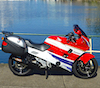
My 1988 Honda Hurricane has only 2,439km on it, having been bought new in 1988, dry stored, unused, from 1989 to 2025, when I purchased it from a friend. Despite the low miles, it actually required a bit of work to get it running again; the chief issue was it was a really hard bike to start when cold.
A check of the plugs showed a rather anemic looking spark and occasionally no spark at all. I looked at this forum and found several owners similarly complaining that their bikes were very hard to start when cold, but started OK once warm. This was my experience too, I would have to spin the engine for an extended period before it reluctantly chimed in on one, then two, then all cylinders. This is obviously not typical of a Honda, usually they leap into life on full choke when cold. The previous owner said that back in 2017 he wanted to start the bike and couldn't get it going. He had tried to sort it out himself and had been into the carbs, before giving up and putting it back in his workshop. When I bought the bike the carbs were loose on the engine, all the bodywork had been removed, and the owner handed me a coffee can full of bolts and no indication as to where they went...
I did, however, managed to solve the hard start issue and thought I would detail what I did in order to help any other owner looking for some troubleshooting ideas.
I installed a two-year old, AGM battery and did a compression check, finding good, even, compression. I rebuilt the carbs, ultrasonically cleaning the stripped bodies, before scrupulously cleaning all the internal passageways. Be careful when removing the mixture screws, underneath the spring is a tiny washer and o ring that, if they are not carefully removed, are likely to get blasted into the darkest corner of your workshop, when you clean the passageways with carb cleaner. In my case two of the four carbs were missing the o ring and washer, however I had spares from my 1985 Yamaha FJ1100 that were a perfect replacement. I carefully lubricated these o rings when I reinstalled them, and returned the mixture screws to factory spec, two turns out.
I then replaced the float needle and seat, and the inline filter on top of the seats; cleaned all the jets, reset the float height, and checked the slide diaphragms for any splits or tears. I paid particular attention to the choke circuit in the carbs, because I didn't smell fuel or see any evidence of flooding on the spark plugs, when I pulled them after attempting to start the bike, and felt this was a bit suspicious. I carefully checked the rubber carb inlet boots for splits or tears that could potentially weaken the mixture.
Lastly I checked for the carbs for leaks on my bench with a remote fuel tank and after a few drips everything settled down and seemed fuel tight.
The air filter was clean and clear, the airbox hand not been filled with dog kibble by mice.. so everything was reinstalled. Exhaust pipes were removed cleaned, checked for dog kibble or other obstructions, before being cleaned and reinstalled. Frame electrical ground by the fuel pump was cleaned up and checked.
I replaced all the spark plugs with new NGK DPR8EA-9's, one step hotter than the NGK DPR9EA-9 ones required. I set the gap to 30 thou, tighter than the 31 - 35 thou suggested in the manual. For electrical diagnostics, I took my multimeter and checked the primary and secondary windings on both coils, the HT wire and HT cap, and the 5 ohm resistor in the plug caps. I checked the pulse generator resistance and everything measured within specifications, as quoted in the official Honda workshop manual. The side stand cut off switch and the clutch lever switch could also potentially be an issue and should be checked.
I checked the continuity between the spark unit (CDI unit) and the coils on the blue/yellow and yellow/blue ignition wires, and also checked for the correct operation of the kill switch in the right hand side handlebar switch cluster.
When I switched the ignition on, I measured the voltage at the black and white hots on both coils and found a 0.9 volt drop when compared to the voltage measured at the battery. I felt this was excessive so, despite the really low mileage on the bike, I disassembled the fuse box, replaced all the fuses with the correct amp type, and cleaned all the loom connections. I unplugged everything I could find in the wiring loom and gave everything a good clean; I didn't find anything concerning in the loom, the only place where there was any slight discoloration on connections was the fuse box, so decided to run 12 volts directly from the battery to the coils, via a four pin relay.
My friend, Kelly, was formerly a service manager for a big Honda dealership in Alberta during the '80's and 90's and he suggested that this was quite a common practice on some Honda models. I used a four pin, normally open, automotive relay (about $20), and ran a hot (with an inline 10 amp fuse) from the battery (using 12 ga wire) to the input on the relay and ran the output of the relay to the 12 volts side of both coils. I disconnected the existing black and white wires from the coil hots and plugged them into the switch side of the relay, so when you turn the ignition on the relay is energized and the switch inside closes. This feeds 12 volts from the battery, direct to the hot on the coil, ensuring that the coils were getting the maximum output from the battery and avoided any issues with voltage drop in the loom.
I checked the operation of the fuel pump and replaced the fuel pump fuel filter. I replaced the fuel pump cut off relay (36100-MM5-008 and about $35), which apparently has an internal diode designed to stop back feeding any voltage spikes to the CDI unit, via the blue/yellow and yellow/blue ignition wires, as the fuel pump switches on and off. Potentially these spikes could cause damage to the CDI unit so I decided to sent my CDI unit to a company called Carmo (www.carmo.ca) who gave it a complete diagnostic check (about $100 including shipping) and found nothing wrong with it and returned it to me with a clean bill of health.
After all this messing about the net result is my bike starts immediately when cold, and you can quite quickly it take off the choke. Unsurprisingly the carbs were way out of balance after being completely disassembled, but I was able to dial them in using my vacuum gauges. The result is an engine that is smooth, with a lovely, fast throttle response.
So what was the the fix? I don’t know if there was a single factor, I suspect that there were several individual issues that on their own would probably not have been a big deal, but cumulatively created the hard start condition.
A fully charged battery is important, I think that if your battery is marginal, the amperage draw when the starter is spinning might pull the voltage down to, or very close to, the minimum required to trigger the CDI ignition unit. This, I think, probably accounted for my seeing intermittent sparks at the plugs, when I was troubleshooting. I traced the low battery condition to a failing battery tender that was no longer capable of charging the battery to a healthy 12.5 volts. This is the second battery tender that has failed on me, so its probably a good idea to keep an eye on them.
Other, non ignition related items that needed work before the bike was ready to ride were seized brakes. This turned out to be the DOT 3 brake fluid having turned into this weird, crystalline, toffee, the crystals had forced the caliper pistons out and applied the brakes. New seals and dust caps were installed, after I eventually managed to remove the calipers and get out the pistons. The pistons would not budge with compressed air, so I installed a grease fitting in place of the bleed nipple, and pumped the calipers full of grease to force out the pistons. I have used this method many times and it always works. The downside is lots of grease to clean up afterwards. I replaced the tires and valve stems and gave the bike a thorough clean. It now looks a million dollars and is ready for its first shake down ride.
If I think of anything else that is relevant I will update; likewise, if my first few rides throw up further issues I will edit this post.
Finally, be aware I am not a trained motorcycle mechanic or automotive electrician; these details are provided to you only as a guide to my troubleshooting thought process and are not advice or recommendations. If you choose to use this information it is completely at your own risk!
Good luck!
Andy
Last edited by SaltyAndy; Mar 30, 2026 at 01:13 PM.
Excellent post, Andy. I concur with your contention that a fully charged battery is important. I finally solved my starting problems when I closely inspected my battery and found that it had been in use for 9 years! I would charge it from time to time, and it would it would work OK, but only for a few days. Now with a new battery, the bike bursts into life. Cheers.
Excellent post, Andy. I concur with your contention that a fully charged battery is important. I finally solved my starting problems when I closely inspected my battery and found that it had been in use for 9 years! I would charge it from time to time, and it would it would work OK, but only for a few days. Now with a new battery, the bike bursts into life. Cheers.
Thank you for the kind comment. I am amazed that you managed to eke out nine years of service from a battery, you must have really looked after it!
My experience seems to be that all batteries kind of die around the four year mark and I am not convinced that spending a lot of money on a battery actually buys you any more useful life. I used to run my Laverda Jota on garden tractor batteries and simply replaced them every two or three years, super cheap.
Poor grounds, corrosion on aging electrical connectors, and batteries at the end of their life all point towards hard-starting issues. Luckily all relatively fixable by a home mechanic who has some time and patience.
This is a good thing; here in British Columbia, Canada there are no commercial bike shops willing to look at a 1988 CBR1000F, the Honda dealers all claim the bike it too old for their mechanics to service and that they cannot find spare parts. I imagine when the current crop of superbikes reaches thirty years old, covered in sensors and using a screen instead of analogue gauges, bikes will become disabled due to the inability to update software...
Looks like mutual support via forums is going to keep us all running!
Fantastic write up, great news that you have solved your problem.
Lets see some pics!
Thanks Al!
I can take a picture of the relay set up next time I have the tank off. I located the relay next to the fuse box, only to keep is a bit isolated from the heat of the engine. I covered the 12 ga wire with a protective sheath where it passed near potential wear points (principally near the battery). When the bike is running, this new wire is, of course, energized. If the bike suddenly died I'd immediately the inline fuse and relay connections.
"Poor grounds, corrosion on aging electrical connectors, and batteries at the end of their life all point towards hard-starting issues." May I add the standard Honda Reg/rec unit. I replaced mine with an Electrex World unit, which I believe offers more charge to the battery at low revs, improving battery service life. Cheers



 1988 CBR1000F Hurricane hard start resolution