When you click on links to various merchants on this site and make a purchase, this can result in this site earning a commission. Affiliate programs and affiliations include, but are not limited to, the eBay Partner Network.
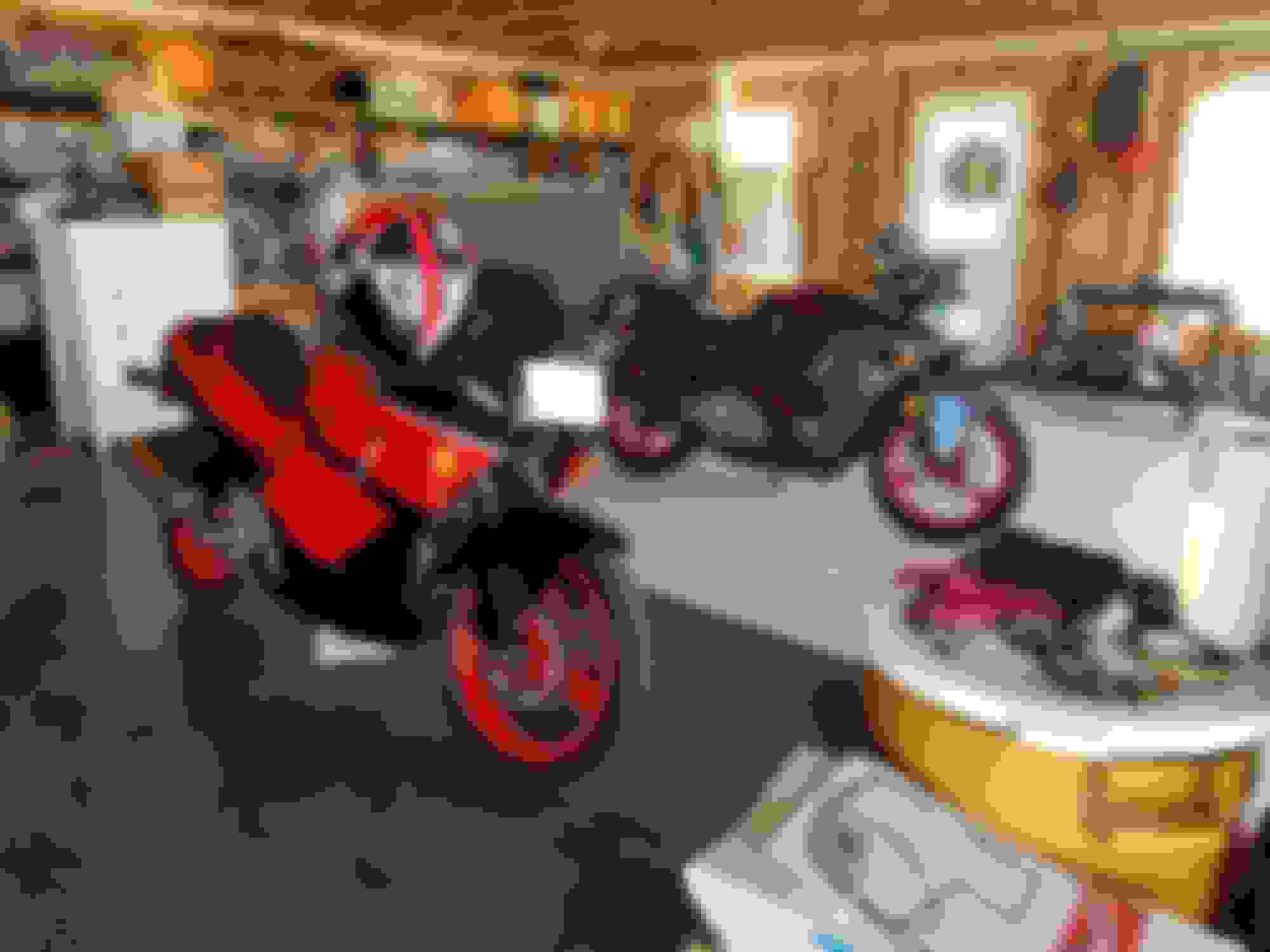
Heyyyy I think you are refering to the "HRC" style of mine. Actualy is a simple custom paint (original was white ) but I love it, everyone love it on the road (lots of comments form car drivers).
Pictures are in Uruguay, capital Montevideo, route 80miles from Punta del Este resort.
cheers!
Originally Posted by emmettcbr600f1
Hey I'm just wondering where all this beautiful images came from.
Expecially the one with the windy road in the background and the three different coloured versions of the Cbr????
this is my 1991 (yes its was registered in 1991) cbr600f jelly mold i have a question my bike has a very unique vin number its JH2PC2327LM00001 now does this mean it was the first of its model to roll of the production line or better still can anyone tell me anything about it ?
Great job!!...great review,..I'm even more excited now than ever about restoring my 88 Here she is , ..2,400 original miles! , ..found it stored in a dealers warehouse in Florida,even had .its original owners manual and tool kit .a few minor cosmetic fixes being done as we speak, new tank, all new rubber grommets and hoses , carburetors rebuild with all nos oem honda parts right down to honda oil abd brake fluid ...
Hi guys,
I had an 87 CBR in London in 1988, then had a long dry spell between bikes. My next bike was a 89 CBR, which I got last month. A few things got in the way during the intervening decades.
Here's some reading I've found. I think its good to collect what has been pu blished, so that the wikipedia nerds can someday get the story right for the CBR600F1.
From "The Ultimate Motorcycle Encyclopedia" C Annes Publishing Ltd 2000,2004
Honda also produced hugely popular middleweight fours, notably the CBR600F, which sold in huge numbers in the 1990s due to its versatility and high performance at a reasonable price. The original CBR600F, launched in 1987, combined a top speed of 135mph (217kph) with excellent handling, comfort and impressive reliability. Regular revisions kept the CBR competitive in motorcycling's most competitive class, while retaining its all-round appeal.
Honda Motorcycle History, Wilson, Hugo, 1998 The CBR600F has been the benchmark middleweight sports bike ever since its introduction in 1987. For starters, the use of all-enclosed body panels was an innovation feature that allowed the engine to be built with aesthetic considerations. Conservative engineering - the CBR has an in-line four cylinder engine and a steel frame - combined with Honda's traditional build quality has made the CBR600 a success.
Actually, I don't agree the engineering is conservative. By water cooling, the bore could be increased, the stroke shortened and RPM increased to create more power. To get all that plumbing in, the fairing was the answer, and gave improved aero too. Water cooling, aero, over square bore/stroke - its all part of the brilliant enabling concept of the CBR600.
Robert L. Shook, Honda, Prentice Hall Press, 1988
Note the publisher, Prentice Hall publishes text books, a very highly reputable source.
In the introduction, Shook says (page v) Shook says: I concluded that Honda is indeed the most intriguing and innovative company of the 1980s.
Then on page 58: To stay in front, Honda consistently dominates the motorcycling racing circuit. In 1986, for example, Honda became the first company to win ten major U.S. race championships. In Daytona, for example, an incredible thing happened. The first fourteen racers to cross the finish line were riding the company's new Hurricane 600 model.
So, yes, the original CBR600F is a breakthrough machine. According to Cycle World, May 1987, page 44,
When it comes to the reasons that the Hurricane works so well, though, what matters more than how Honda did it is that Honda did it. The Hurricane is a rational middleweight sportbike that demonstrates an almost irrational level of performance. Irrational, at least, by the old standards of middleweight sportbiking-the standards that seemed so impressive just four years ago. But four years can be a very long time. For middleweight sportbikes, its been long enough to witness the passing of the era of the pocket rocket. And the dawn of the age of the 600cc Superbike.
The CBR600F is the dawn of the 600cc superbike. That makes it a very important machine in the history of motorcycling.
Here is an extract from another piece Titled The Birth of a Dream, by Juliian Ryder, which is the introduction chapter in the manual. "Honda CBR600F1 & 1000F Fours" by Mark Coombs and Penny ***.
Sorry if the line breaks are weird, I did OCR from a photo of the page.
The Honda CBRs
The CBRs continued the Honda
tradition of DOHC four-valves-per
added water cooling for the first time. This
was in line with industry trends, but
eschewing expensive aluminium frames in
favour of good old steel wasn't. Neither
was the all-enclosing bodywork and big,
flared front mudguard which some
observers found a little bulbous for their
tastes. Those air intake scoops either side
of the headlight showed that the
designers
had spent a lot of time on the problem of
feeding the motor with a supply of slightly
pressurised, still
air
internal
aerodynamics they called it.
Aesthetics aside, there was no doubt
that Honda achieved their design aims of
over 130 bhp per litre from both the 600
and 1000 yet still managed to shrink the
dimension of the motor compared to the air-
cooled fours in all directions. Valves were
waisted, camshafts were hollow, piston
rings thinned down, a typical inventory of
Honda attention to detail. The valve gear
consisted of rocker arms pivoting on ball-
and-pillow joints in the head thus liberating
room for a straight inlet tract with a good
degree of downdraught. The layout bore a
very close resemblance to the arrangement
on the VFR750 which was launched a year
before the CBRs.
The only internal differences between the
600 and 1000 were that the 600 had a
balance shaft gear-driven directly off the
crankshaft and the 1000 had its alternator
mounted piggy-back behind the cylinders to
keep its engine width acceptable. Both bikes
avoided the fashionable pitfall of 16-inch
front wheels and used 17-inch front wheels
that gave quick steering without
compromising stability.
CBR
The DCBS (Dual Combined Braking System) CBR1000F model
There wasn't anything startling about the
spec sheet of the CBRS when they were new
and in many ways there still isn't. It is
therefore remarkable that the 600 effectively
invented the Supersport 600 class and then
continued to dominate it and fill the best-
seller slot in countries all over the world. The
first 600, the F-H stayed basically unchanged
for four years until the F-M arrived in 1991. In
that time, initial suspicion engendered mainly
by its looks, disappeared as the CBR600
dominated the new Supersport 600 racing
class and revealed itself as the best road-
going all-rounder in its sector of the market.
When the Supersport 600 class got its own TT
in 1989, Steve Hislop won it on a CBR600
averaging over 112 mph for the 150-mile race.
But unlike some other bikes in the class, the
private owner could load his CBR600 up with
luggage and a passenger and go touring in
comfort.
Up to the time of writing, the 600 had been
comprehensively revamped twice but the
1000 has remained largely unchanged save
for the suspension and bodywork being
updated for the F-K model in 1989. The
P-model that appear in late '92 was used to
showcase a mechanical linked-braking
system that Honda hoped would give some of
the advantages of electronic ABS without the
cost.
But where the 1000 was a perfectly good
bike in the big sports tourer class, stuffed full
of exceptional bikes, the CBR600 was a
remarkable bike in a class that was at the
cutting edge of both technology and sales. To
achieve that with what at first sight looks like
a conservative design is a remarkable feat.
We expect a bit of hyperbole from writers I suppose but still that is a pretty strong statement, written after 20 years of the CBR600.
I think it might be time to see if the wiki editor bouncers will let us in? Suggestions welcome. Wiki likes quotes from solid references. Let me know what strikes you as worthy of the wiki entry.
A general walk around of a very, very nicely preserved 1989 model, and then! at 9:10 into the video, we hear from a guy that raced one at Daytona in 1987/88. Very impressive insights.
I found a reference to the CBR400 Aeroof 1986, which was designed in the same family and at the same time as the 600, 750 and 1000. The article lends insight to the design origins of the CBR, although you'll have to trust the translation as the original is in Japanese. This bats away the notion that Honda copied the fully enclosed aesthetic of the 1986 Ducati Paso. Lets get real, Soichiro Honda would rather die than copy something: “I’d sooner die than imitate other people… That’s why we had to work so hard! Because we didn’t imitate.” – Soichiro Honda (https://succeedfeed.com/soichiro-honda-quotes/) I hope you enjoy this little backstory.https://www.bikebros.co.jp/vb/sports...ppanmiddle-60/
HONDA CBR400R (1986)
The aerodynamic benefits of the cowl are not limited to replicas. The CBR400R is a new concept model that combines this with a new water-cooled straight-four engine.
Fully covered car with new concept
The times always yearn for new things. The same goes for the motorcycle world, of course. The mid-1980s, which is covered in this series, was a time when such movements were particularly active. With the motorcycle boom, there was also a strong trend that new things were better. Water-cooled engine, aluminum frame and various new devices. Disc brakes and monosuspensions also fall into this category.
After that, the racer replica route, which has come up many times, was being pushed forward. All the more so because the aforementioned "new thing" had a strong meaning of feedback from that. The same was true for the cowl that was approved domestically in the summer of 1982. However, the CBR400R that we will be introducing this time was new, but it was different from a replica.
Honda's actions seem surprising. The air-cooled 4-engine sports group such as CBR400F/F-III/Endurance followed the replica route, and the cowl was also installed in a replica style. However, the CBR400R, which is water-cooled and has the name CBR, is not in the flow of replicas. Because there was V4. When the VF750F and later the VF400F were introduced in 1982, Honda made it clear that V4 would be the core of racing. That's why I chose a different flow for straight-4.
The V4 VFR400R, which appeared in March 1986, adopted a cam gear train, and the style is naturally a replica. The straight-four CBR400R, which was released in July of the same year, was equipped with new mechanisms such as a cam gear train, but the style was not a replica.
The first fully covered body made in Japan that completely encloses everything except the suspension area. The headlight is also atypical. Honda called this "near-future form." A near future that we have certainly never seen before. The CBR600F, an export car developed at the same time with an iron frame + normal cam chain, the CBR750 Super Aero introduced in 1987, and the CBR1000F, also an export car, all adopted a similar fully covered body, with a new sports inline 4 engine. propose.
This cowl did more than simply rectify the outside air. Paying attention to the air flowing inside the body, an inner fender (hugger) is installed above the swing arm to actively flow air inside the body to the rear of the vehicle. This increases the efficiency of the intake of fresh air required by the engine and quickly dissipates engine heat, reducing the burden on the rider. These functions are named interactions. In fact, the amount of hot air from the engine is reduced, drastically reducing the risk of low-temperature burns caused by the heat of the frame. Unprecedented comfort for a 4-cylinder super sports car has been ensured through measures such as reducing turbulence inside the cowl.
Inside that body was a body and engine that were built like Honda. The frame has an aluminum swing arm and a 17/18 inch S-shaped 3-spoke wheel. The tires are flat, and other companies had already started using radial tires, but CBR has bias tires. This is due to its reliability and balance, and in fact, it showed high-quality handling with no quirks at any speed range.
What was typical of Honda was the adoption of a 35-degree forward tilt cylinder. Yamaha proposed the ``Genesis philosophy'' of a low center of gravity and high efficiency with a cylinder tilted forward at 45 degrees, but Honda tilted the cylinder forward at 35 degrees and set a cam gear train. Accurate valve operation at high speeds and reduced frictional resistance have enabled the car body to be made more compact.
However, perhaps the times did not catch up with the look of a cutting-edge sport other than a replica, and the color of the CBR400R was changed the following year in 1987, and in early 1988 the valve was changed to a direct-drive type, but it had almost the same configuration as the replica style with dual headlights. The model was changed to the CBR400RR, which became very popular.
At the beginning, I said that I long for something new, but there is a trend in which new things are accepted. It seems that the newness of the CBR400R came a little early.



 Beautiful Images


 I think you are refering to the "HRC" style of mine. Actualy is a simple custom paint (original was white ) but I love it, everyone love it on the road (lots of comments form car drivers).